TV REVIEWS / Avatar: Seven Havens / SEASON 1
Avatar: Seven Havens Review: 225 Years Later, Avatar Hasn't Missed a Beat
So when you announce a new Avatar series set 225 years after The Legend of Korra, with an entirely new world and two Avatars, there's a lot that could go wrong.
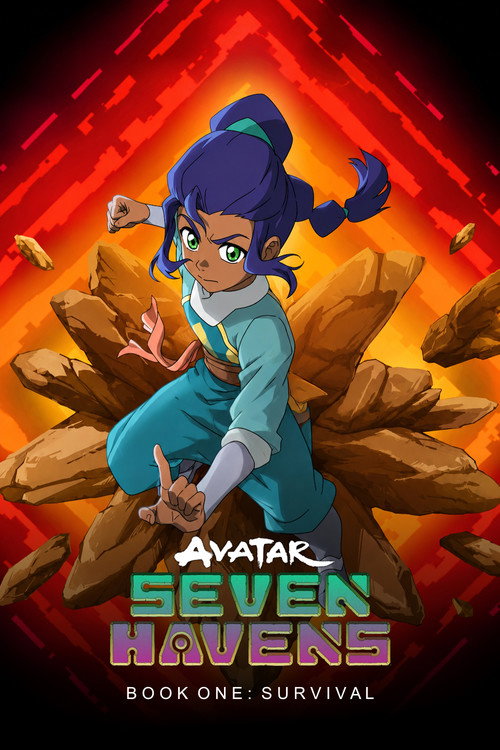
ABOUT THE SHOW / SEASON 1
Avatar: Seven Havens
2026 · Animation · Action & Adventure · Sci-Fi & Fantasy · Family
- Created by
- Michael Dante DiMartino, Bryan Konietzko
- Cast
- Saheli Khan as Pavi (voice)Aishwarya 'Aishu' Devan as Nisha (voice)Major Curda as Jae (voice)Akshay Khanna as Karthik (voice)Sakina Jaffrey as Agam (voice)

This product uses the TMDB API but is not endorsed or certified by TMDB.
I just finished the first book of Avatar: Seven Havens, and I have to say, it exceeded every expectation I had.
I've always considered Avatar: The Last Airbender to be practically perfect television. The character development, the seasonal arcs, and the way its larger story comes together across three books are some of the best examples of long-form storytelling out there.
So when you announce a new Avatar series set 225 years after The Legend of Korra, with an entirely new world and two Avatars, there's a lot that could go wrong.
But they pulled it off.
And more importantly, they've managed to create something that feels entirely new without losing what made Avatar special in the first place.
Seven Havens is a story about belonging, isolation, heartbreak, trust, and distrust. And while the original Avatar certainly wasn't afraid of darker subjects, it was still primarily designed for children, particularly in its earlier episodes. Seven Havens feels more grown up, and the season finale makes that abundantly clear.
Two Avatars, Two Very Different Lives
At the heart of this season are Pavi and Nisha, two Avatars who have experienced the world in completely different ways.
Both have lived lives defined by isolation, but for different reasons. One has been isolated by circumstances beyond her control, while the other has built walls around herself. One wants to prove herself, while the other struggles with the expectations placed upon her.
The writers spend 13 episodes showing us how those experiences shape their understanding of trust, relationships, and their responsibilities as the Avatar.
And throughout all of it, you're rooting for them.
You want them to find each other. To understand each other. To realize they don't have to face everything alone.
Then the finale tears them apart.
That moment works because the season earned it. Their separation isn't simply a dramatic twist. It's the emotional culmination of everything we've watched these characters experience.
And it makes one thing clear: their story is far from over.
The Mystery Is the Point
Throughout the season, Seven Havens constantly challenges our assumptions about what's happening in this world.
Early on, I was convinced the Havens existed inside the Spirit World. Between the music, the strange environments, the lights overhead, and little references scattered throughout the episodes, something didn't seem quite right.
But as the season progressed, that theory became increasingly difficult to sustain.
And the questions kept piling up.
Why are the Faceless kidnapping benders? Why are dark spirits attacking people? Why are the Havens so hesitant to communicate with one another? What actually happened to Korra, and how did the Avatar become someone humanity fears?
Then there's Pavi and Nisha themselves.
Why does Nisha have this darkness surrounding her, while Pavi seems to have a stronger connection to spiritual enlightenment and her chakras?
There are so many directions this story could go.
And sure, I want answers. But I don't need them yet.
That's an important distinction.
The mystery isn't something I'm trying to solve in this review. It's something I'm enjoying watching unfold.
The writers give us enough information to build theories, challenge those theories, and reconsider what we thought we understood. Meanwhile, we're still getting action, adventure, humor, and meaningful character development.
The story is moving forward. It just isn't explaining everything along the way.
And for a series built around a much larger narrative, that's exactly how it should be.
A New World Without Losing Avatar's Heart
Setting Seven Havens 225 years after The Legend of Korra was an incredibly smart decision.
Korra inherited a recognizable world from The Last Airbender. We knew the nations, the history, and many of the characters who had shaped that world.
Seven Havens has the freedom to build something almost entirely new.
The writers don't have to constantly explain what happened to every familiar character or rely on nostalgia to keep us invested. They can introduce new societies, new conflicts, and a completely different understanding of what it means to be the Avatar.
And they have.
The world feels unfamiliar, but not disconnected. Korra remains an important part of the story, and the Easter eggs are there for longtime fans without overwhelming the new characters.
Yet beneath all those changes, Avatar's identity remains intact.
The humor, the adventure, the emotional stakes, and the relationships that give everything meaning are still here.
After 225 years, it somehow feels like they haven't missed a beat.
Jae and the Power of a Season-Long Character Arc
Jae might be my favorite character in this entire show.
When we're introduced to him, he's an energetic, impulsive bender who could have easily remained comic relief.
But over 13 episodes, he grows into someone more thoughtful, independent, and willing to take responsibility for his own future.
By the finale, he's choosing to leave the Haven and accompany Pavi on the next stage of her journey.
He's choosing uncertainty over familiarity.
It's a meaningful decision because we've watched him become someone capable of making it.
And that's what great character development looks like. Not some sudden transformation, but a series of experiences that gradually change how someone sees themselves and the world around them.
The Jae we meet in Episode One isn't the Jae we leave behind in Episode Thirteen.
That transformation is also a perfect example of why I think some of the criticism surrounding Seven Havens misses the bigger picture.
Let the Story Breathe
One of the most consistent criticisms I've seen is that Seven Havens only has 13 episodes, so the story needs to move faster.
But does it?
Avatar has always thrived on long-form storytelling. The Last Airbender had roughly 20 episodes per season, giving its characters and mysteries room to develop. Not every episode needed to deliver a major revelation because the writers were building toward something larger.
And that's exactly what Seven Havens is doing.
We're living in an era where audiences binge entire seasons in a weekend, expect increasingly shorter seasons, and sometimes treat unanswered questions as storytelling failures.
But there's a contradiction there.
We want complex characters, layered mysteries, and emotionally satisfying stories, yet we often expect all of those things to develop immediately.
Take Jae. If you'd judged his character after three episodes, you'd have missed the transformation that makes his finale decision meaningful.
Or Pavi and Nisha. Their relationship carries the emotional weight it does precisely because the writers spent an entire season developing it.
That's also why I've moved away from reviewing television episode by episode. I prefer experiencing a complete season before evaluating the story it's trying to tell.
Now, that doesn't mean individual episodes can't have pacing problems. They absolutely can.
But there's a difference between a story that's failing to deliver and a story that hasn't finished delivering.
Seven Havens has a complete seasonal arc while simultaneously establishing a much larger series arc. We don't have all the answers about Korra, the spirits, or the world these characters inhabit because those mysteries are still unfolding.
And that's okay.
Not every story needs to move at breakneck speed. Sometimes the best thing a show can do is make you wait.
A Finale That Changes Everything
By the time the finale arrived, I was completely invested in these characters.
The writers had spent the season exploring how isolation shapes Pavi and Nisha, how their different experiences affect their ability to trust, and what finding a connection means to both of them.
Then they pulled that connection apart.
It hurts because it matters. And it matters because we spent 13 episodes getting there.
The finale doesn't need to explain every mystery or resolve every conflict. It delivers an emotional payoff while fundamentally changing the direction of the story.
With Books Two, Three, and Four announced, there's still plenty of room for the larger narrative to unfold.
And I hope the writers continue approaching this story the way Avatar traditionally has: with a clear narrative in mind rather than stretching things out simply because audiences want more.
A great story doesn't need to last forever. It needs to know what it's building toward.
Final Thoughts
Avatar: Seven Havens has given us a new world, two compelling Avatars, a wonderful supporting cast, and a mystery that could take this story in countless directions.
More importantly, it's managed to preserve the heart of a franchise that's been telling extraordinary stories for decades.
The first book explores belonging, isolation, trust, and heartbreak without rushing toward easy answers. Its characters grow, its world becomes more complicated, and its finale delivers an emotional payoff that makes the next chapter feel essential.
If you gave up after a handful of episodes because the story wasn't moving quickly enough, I'd encourage you to give the entire first book a chance.
Because there's something special happening here.
I don't know exactly where Pavi and Nisha's journeys will take them, what happened to Korra, or what the larger mysteries will ultimately reveal.
And I couldn't be happier about that.